




our case study
How a Healthcare Group Increased Annual Revenue by 30% Across Four Payer Contract Renewals
A fund-backed healthcare group operating across 11 U.S. states was preparing for major payer contract renewals. Their team suspected reimbursement rates were below market, but they lacked the data to prove it.
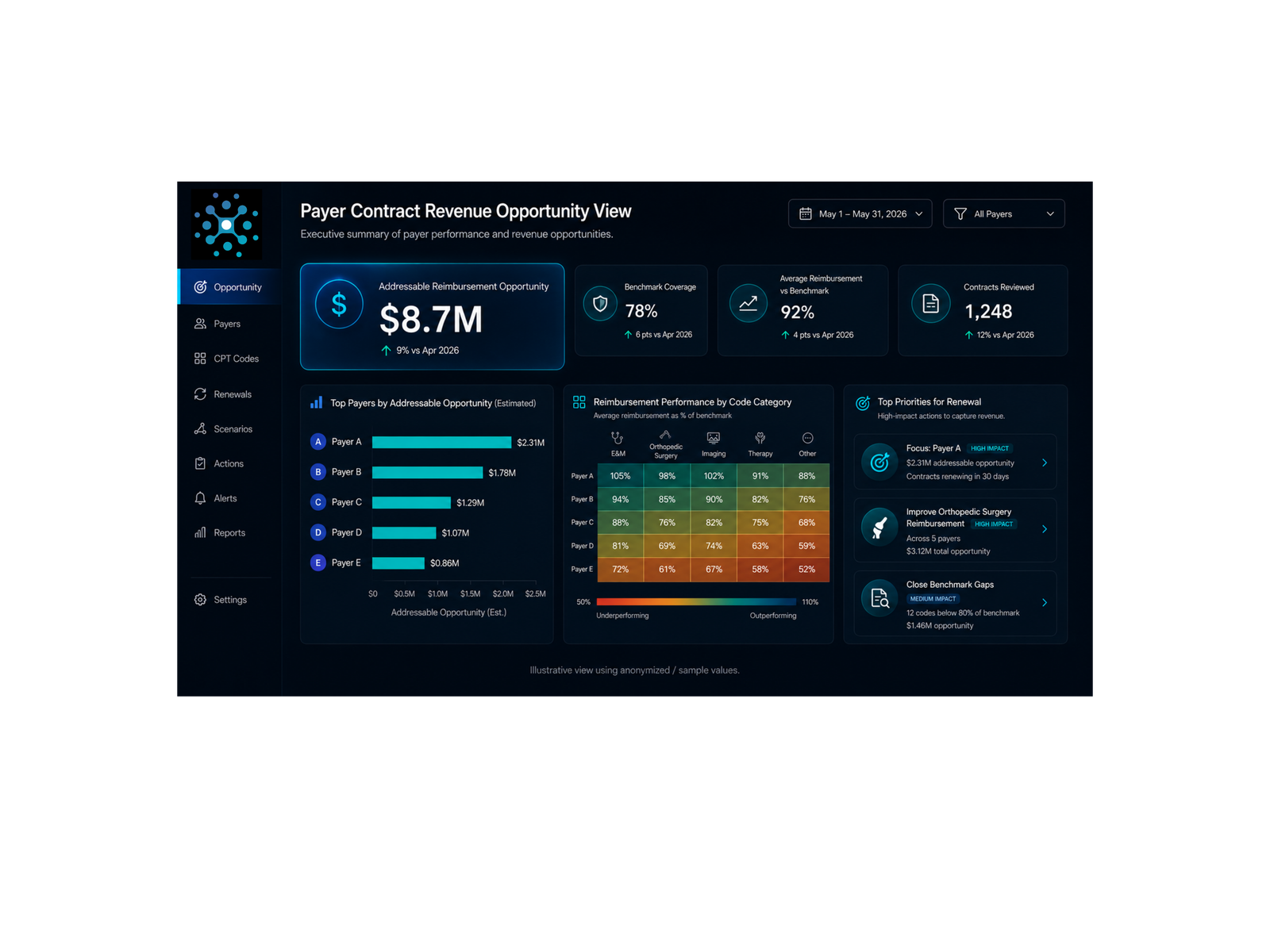
Tech Detectives helped the company design and implement a CPT-level payer reimbursement intelligence system that combined market benchmarks, reimbursement rates, procedure volume, and revenue opportunity logic into one negotiation-ready view — contributing to a 30% annual revenue lift across four payer contract renewals.
For example, if a procedure was reimbursed $200 below the target benchmark and performed 1,000 times per year, that CPT code represented $200,000 in annual revenue opportunity.
The intelligence layer helped the director move from asking, “Are we underpaid?” to answering, “Which payer, which CPT code, how far below market, and how much revenue is at stake?”
At the center of the system was a simple revenue opportunity model: Revenue opportunity = annual procedure volume × reimbursement rate gap
This turned rate differences into dollar impact, helping the contracting team prioritize the codes and payer contracts that mattered most.
| Before | After |
|---|---|
| Manual payer Research | Repeatable payer reimbursement intelligence system |
| Directional assumptions | CPT-level evidence |
| Difficult to prioritize contracts | Revenue opportunity ranked by payer and code |
| Negotiations based on estimates | Negotiations backed by financial impact |
| Growth dependent on more patient volume | Growth through better reimbursement rates |
How Tech Detectives Helped
Tech Detectives served as both a revenue strategy and implementation partner, helping the client move from uncertainty around payer data to a working reimbursement intelligence system.
The work started with a proof of concept to test whether newly ingested payer data could answer high value contracting questions. Once the client saw that the data could reveal meaningful reimbursement gaps, we ingested historical payer data and modeled it around CPT codes, payers, regions, provider types, facility status, and annual procedure volume.
From there, we moved into full implementation: source data ingestion, change data capture, refresh logic, data modeling, metric definition, and dashboard development based on the payer contracting team’s business use case.
| Stage | What Changed |
|---|---|
| Revenue opportunity validation | Revenue opportunity validation Tested whether newly available (external) payer data could reveal meaningful reimbursement gaps |
| Reimbursement intelligence modeling | Organized payer, CPT, region, provider type, facility status, and procedure volume into a usable business model |
| Operational implementation | Built the repeatable process needed to refresh data, maintain logic, and support ongoing contract decisions |
A separate architecture breakdown explains how this type of reimbursement intelligence system can be implemented behind the scenes.
Testimonial
What They Say About Us?
Lorem ipsum dolor sit amet, consectetur adipiscing elit. Ut elit tellus, luctus nec ullamcorper mattis, pulvinar dapibus leo.
Lorem ipsum dolor sit amet, consectetur adipiscing elit, sed do eiusmod tempor incididunt ut labore et dolore magna aliqua.